Why Representation in Children's Books Matters More Than You Think
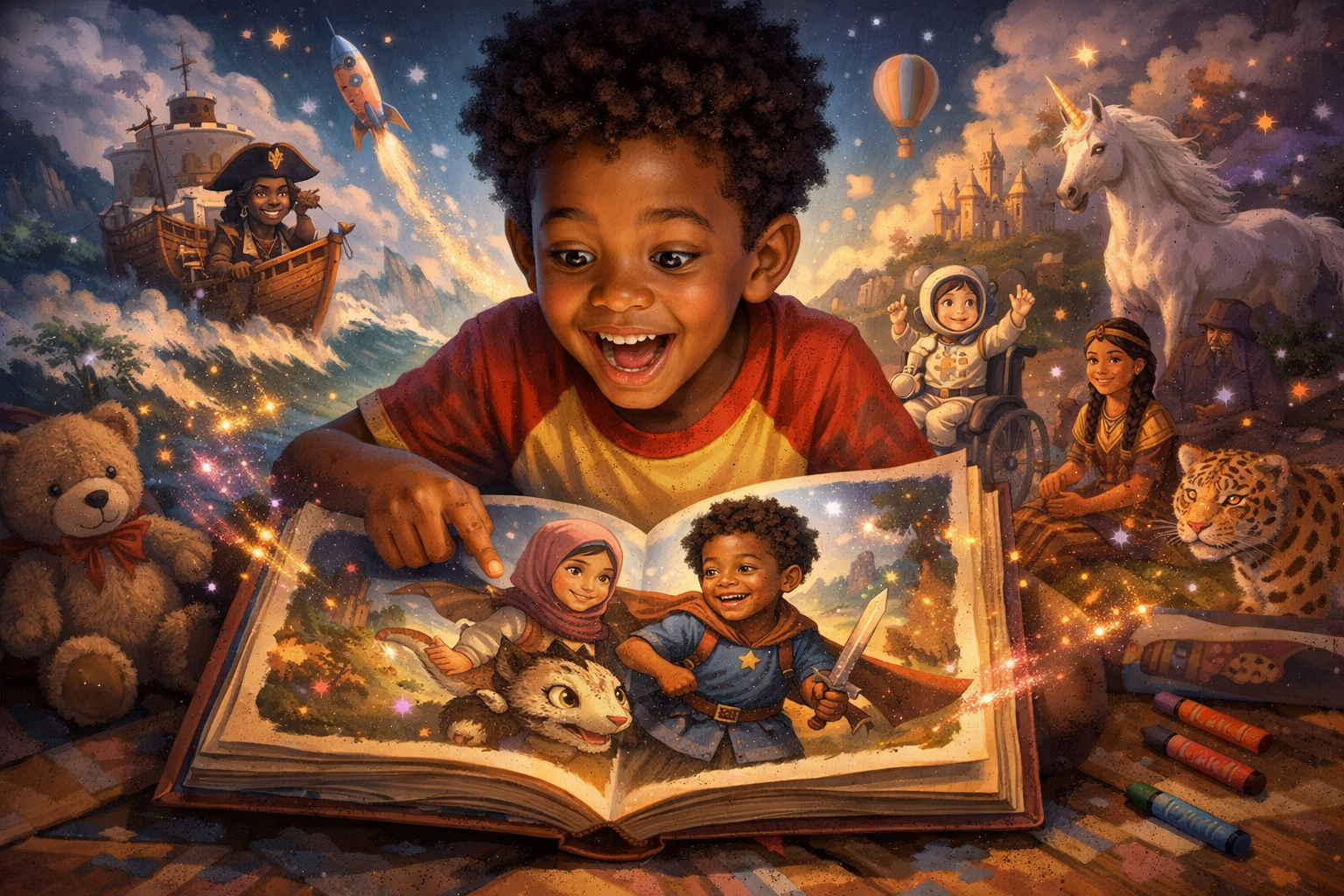
Picture a child curled up with a book, flipping through page after page, searching for someone who looks like them. Maybe they find that character. Maybe they don't. That moment, small as it seems, leaves a mark.
Representation in children's books is not a trend or a political statement. It is a developmental need. The stories children consume shape how they see themselves, how they treat others, and what they believe is possible for their lives.
What Representation Really Means
When we talk about representation in children's books, we mean more than skin color. It includes:
- Ethnicity and culture — characters who reflect a child's heritage, language, and traditions
- Family structures — single parents, same-sex parents, grandparents raising grandchildren, blended families
- Ability and neurodiversity — kids who use wheelchairs, wear hearing aids, or think differently
- Body types — children who don't fit the narrow mold most illustrations default to
- Gender expression — characters who break stereotypes or challenge what "boy" and "girl" stories look like
When a child opens a book and sees someone like them living an adventure, solving a problem, or being loved, it sends a message that cannot be replicated any other way: you belong here too.
The Psychological Impact on Children Who See Themselves
Developmental psychologists have studied the effects of mirrors and windows in literature for decades. The framework, introduced by scholar Rudine Sims Bishop, describes books as either mirrors (reflecting a child's own identity) or windows (offering a view into someone else's world).
Children need both. But they need the mirror first.
When children consistently find themselves in stories, they develop a stronger sense of identity and self-worth. When they never do, the absence sends its own message: people like you are not worth writing about.
Research backs this up. Studies show that children who see themselves represented in books and media report higher self-esteem and are more likely to engage with reading. The story becomes personal. And personal stories stick.
The Impact on Children Who Don't See Themselves
This is where the stakes become even clearer.
Children who rarely find themselves in books often internalize the idea that the "default" child in stories is not them. Over time, this can shape how they relate to learning, to reading, and to their own identity.
A 2019 report by the Cooperative Children's Book Center found that although diversity in children's publishing has improved, characters from many ethnic backgrounds remain significantly underrepresented relative to the actual population of children reading those books.
Children notice absence. When a child of color grows up reading only stories centered on white protagonists, or a child with a disability never sees themselves as the hero, the message is absorbed quietly but deeply.
This does not mean children cannot enjoy stories about characters different from them. Of course they can, and they should. But there is no substitute for the moment a child points at a page and says, "That's me."
What Representation Does for All Children
Here is something often overlooked: diverse books benefit every child, not just those from underrepresented groups.
Children who grow up reading stories about characters from different backgrounds develop:
- Greater empathy — experiencing life through another's perspective builds emotional understanding
- Reduced bias — familiarity with different cultures, abilities, and families normalizes difference from an early age
- Broader curiosity — exposure to varied experiences sparks questions and opens conversations at home
- Critical thinking — seeing the world from multiple angles teaches kids that there is rarely just one way to see things
A child who grows up with a diverse bookshelf grows up better prepared to live and work in a diverse world.
Empathy is not taught through lectures. It is built through stories. Books let children safely inhabit experiences and emotions far outside their own, and that practice translates into how they treat people in real life.
The Role of Personalization
One of the most direct ways to ensure a child sees themselves in a story is to make them the main character.
Personalized books do exactly that. Rather than hoping the right representation exists on a shelf somewhere, a personalized story puts your child at the center: their name, their appearance, their family, their world.
This is not a workaround for the broader need for diverse publishing. Both matter. But personalization offers something uniquely powerful: complete, immediate reflection.
A child who has always felt invisible in books suddenly holds a story where they are unmistakably the hero. That experience is hard to overstate.
How to Build a Bookshelf That Reflects the World
If you want to be more intentional about representation in what your child reads, here are a few practical steps:
-
Audit what you already have — Look at the main characters across your child's books. Who is centered? Who is missing?
-
Seek out own-voices authors — Books written by authors from the communities they depict tend to offer more authentic, nuanced representation.
-
Don't make it a lesson — The best diverse books are simply great stories that happen to feature diverse characters. Let the story do the work.
-
Talk about what you read — Ask your child what they noticed, what surprised them, what felt familiar. These conversations deepen the impact.
-
Add a personalized book — Give your child a story where they are the hero, front and center, in a world that reflects their own.
A bookshelf that reflects the full range of human experience is one of the greatest gifts you can give a child. It tells them: the world is wide, and there is room for you in it.
Every Child Deserves to Be the Hero
The stories we give children are not just entertainment. They are the earliest maps children use to understand themselves and the world around them.
When those maps are narrow, children's sense of possibility narrows with them. When those maps are rich and varied, children grow up knowing that adventure, courage, and belonging are available to everyone, including them.
Start with your child's story. Give them a book where they are the main character, because every child deserves to see themselves as the hero of their own adventure.
Create Your Own Personalized Story
Transform your child into the hero of their own adventure with our AI-powered story creator.
Start CreatingRelated Posts
Summer Reading Challenge for Kids: A Simple Plan That Actually Works
Worried about the summer slide? A low-pressure summer reading challenge can keep kids reading all season without battles or boredom. Here's a simple plan that actually sticks.
The Power of Reading Aloud: Why Your Voice Is the Best Story Your Child Will Ever Hear
Reading aloud to children does far more than entertain. It builds language, deepens bonds, and creates memories that last a lifetime. Here's why your voice is the most powerful storytelling tool you have.
Beyond the Bedtime Story: 5 Other Moments Perfect for Reading Together
Bedtime isn't the only time reading works. Discover five everyday moments that are just as good, sometimes better, for sharing a story with your child.