Screen Time vs. Story Time: Finding the Balance for Young Readers
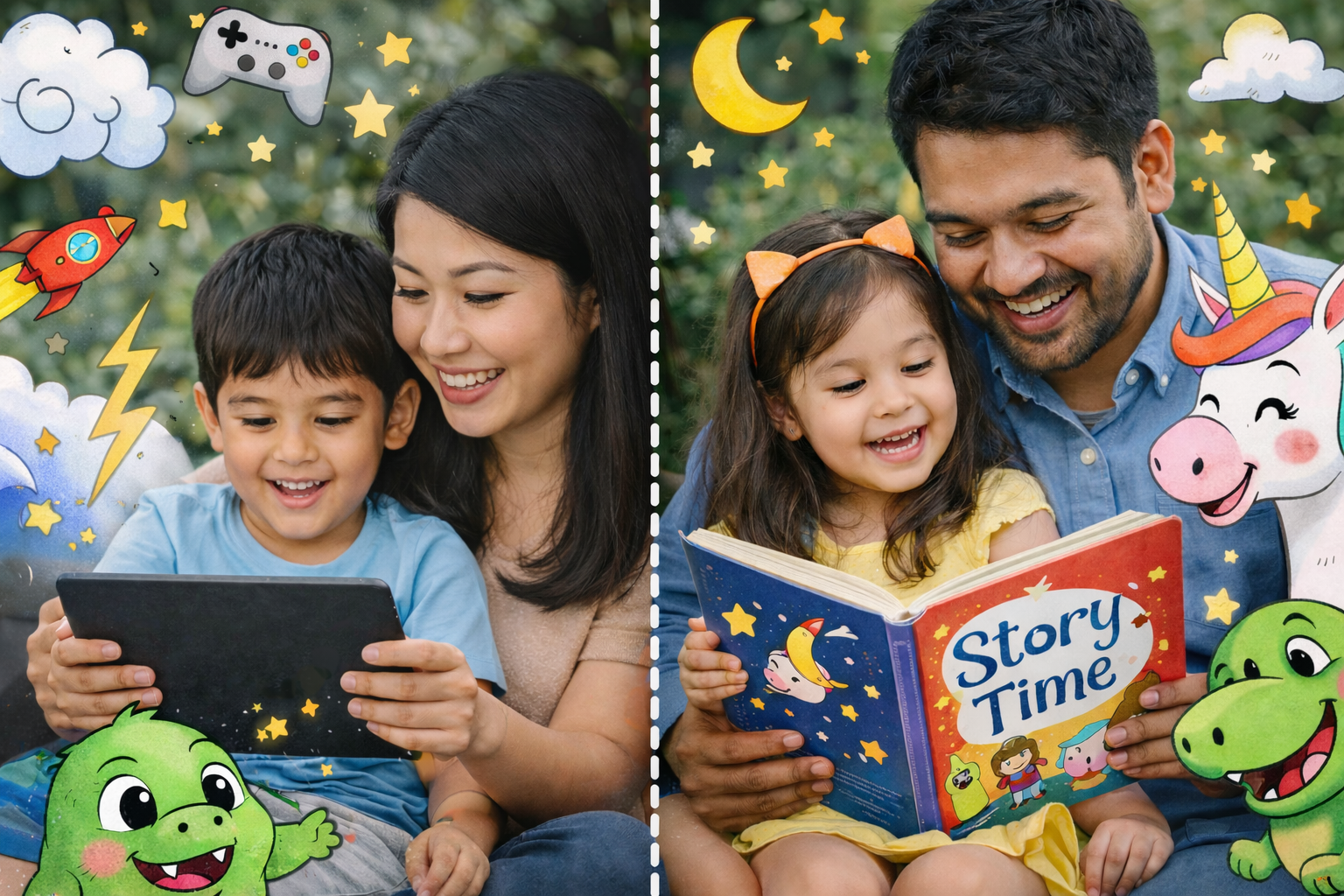
Every parent has been there. It is a Saturday morning, you need twenty minutes of quiet, and handing over a tablet feels like the path of least resistance. The child is calm. You get your coffee. Nobody cries. And then the guilt sets in.
The screen time conversation is one of the most loaded in modern parenting. But most of the anxiety around it comes from treating screens as a single, uniform thing and books as automatically virtuous. The reality is more nuanced, and more useful.
The Problem With the Binary
"Screen time bad, books good" is a simple rule that does not hold up. A child watching a nature documentary is doing something meaningfully different from a child swiping through algorithmically-generated short videos. A child reading a book they hate is getting less out of it than a child watching an educational show they are deeply engaged with.
The question worth asking is not "how do I eliminate screens?" but "what does my child actually need more of, and how do I make that the more appealing option?"
Research consistently shows that passive, fast-paced screen content reduces attention span and language development in young children. But interactive, slow-paced, or co-viewed content tells a different story. Context matters more than the device itself.
What Screens Do Well (and Where They Fall Short)
Screens are good at a few things: delivering novelty, stimulating reward circuits in the brain, and requiring very little from the viewer. That combination makes them genuinely hard to compete with in the short term.
But that ease is also their limitation. Passive screen consumption does not build vocabulary the way conversation and reading do. It does not develop imagination the way open-ended stories do. And it does not create the kind of sustained attention that children need for school and life.
Children who are read to regularly develop vocabularies that are significantly larger than those who are not. At age five, children from homes where reading is a daily habit know an estimated 1.4 million more words than children who are rarely read to.
The gap is not about intelligence. It is about exposure. Stories, especially read aloud, are one of the richest sources of language and emotional modeling that children have access to.
A Framework That Actually Works
Instead of counting minutes, think in terms of what each activity offers. Ask three questions:
Is it active or passive? A child building something in a creative app is more engaged than one watching auto-playing videos. A child asking questions during a read-aloud is more active than one staring blankly at a page.
Is it social or solitary? Watching together, discussing what you just read, or taking turns guessing what happens next all change the nature of the activity. Co-engagement matters more than medium.
Does it lead somewhere? The best activities, whether screen-based or not, spark curiosity that extends beyond the session. A child who finishes a dinosaur documentary and then wants a dinosaur book is showing healthy cross-engagement. A child who finishes one show and immediately demands another is in a loop.
Making Story Time Competitive
The honest challenge for any parent is that books have to earn attention. They are not inherently captivating to every child by default, especially in a household where faster stimulation is available.
Here are the things that actually move the needle:
- Make it a choice, not a sentence. "Do you want to read before or after your bath?" gives children agency. "We are reading now" can feel punitive, especially if it follows taking away a screen.
- Let them pick badly. A child who chooses a book about garbage trucks over your carefully curated literary pick is still choosing a book. Take the win.
- Be present. Reading alongside your child, asking questions, laughing at the funny parts, creates a social experience that most screens cannot replicate one-on-one.
- Match the book to the child. A reluctant reader handed a book that bores them will not become a reader. A child handed a book about exactly what they love right now has a chance.
The single biggest predictor of whether a child will enjoy reading is whether they have experienced a book they genuinely loved. One great book at the right moment can shift a child's relationship with reading entirely.
The Personalization Advantage
One reason screens hold attention so effectively is that they are designed to be relevant. Algorithms surface content based on what a child has already shown interest in. The experience is tailored, even if imperfectly and often manipulatively so.
Books have traditionally not worked that way. You pick a book, it is what it is, and hope for the best.
Personalized books flip that equation. When a child opens a story and finds their own name, their pet, their best friend, their favorite color woven through the pages, the book stops feeling generic. It feels like it was made for them, because it was.
For parents trying to shift the balance toward reading, a personalized book is one of the most reliable tools available. Children who resist generic stories often become completely absorbed when they are the main character.
This is not a gimmick. The engagement is real because the emotional investment is real. A child who sees themselves saving the day, solving the puzzle, or going on the adventure has a reason to turn the page that no algorithm assigned them.
What a Balanced Week Can Look Like
Balance does not mean equal time. It means intentional time. A loose framework that works for many families:
Protect certain moments for reading. Bedtime, the first twenty minutes after school, or weekend mornings before screens turn on. These anchored windows make reading the default in at least some parts of the day.
Avoid using screens as the default transition filler. Waiting at a restaurant, riding in the car, the gap between activities: these are moments where a book or audiobook can do the same job without the same cost to attention.
Use screens as a reward, not a right. When screen time is framed as something earned rather than something automatic, children treat it differently and often find they want it less urgently.
Co-watch instead of offloading. When screens do happen, be there. Ask what is happening. Connect the show to a book you could read about the same topic. Turn passive consumption into a conversation.
The Goal Is Not Zero Screens
Children growing up today will live and work in a world saturated with screens. The goal is not to raise children who avoid them but children who can choose what deserves their attention.
A child who regularly experiences the depth and quiet pleasure of a great story is building the inner resources to make that choice well. They know what sustained engagement feels like. They know the difference between killing time and actually enjoying something.
That knowledge does not come from limiting screens. It comes from giving children something better to choose.
If you are looking for a place to start, find a book that feels made for your child. Better yet, make one. A story that puts them at the center of the adventure is the kind of thing that competes with a screen and wins.
Create Your Own Personalized Story
Transform your child into the hero of their own adventure with our AI-powered story creator.
Start CreatingRelated Posts

Summer Reading Challenge for Kids: A Simple Plan That Actually Works
Worried about the summer slide? A low-pressure summer reading challenge can keep kids reading all season without battles or boredom. Here's a simple plan that actually sticks.
The Power of Reading Aloud: Why Your Voice Is the Best Story Your Child Will Ever Hear
Reading aloud to children does far more than entertain. It builds language, deepens bonds, and creates memories that last a lifetime. Here's why your voice is the most powerful storytelling tool you have.

Beyond the Bedtime Story: 5 Other Moments Perfect for Reading Together
Bedtime isn't the only time reading works. Discover five everyday moments that are just as good, sometimes better, for sharing a story with your child.